

Data Center Relocation Project Plan and Checklist
Professional Services

Organizational growth and change happen. Eventually, an organization will outgrow its current infrastructure, at which point a data center relocation project may become unavoidable.
When your growth warrants more than a simple install/move/add/change (IMAC), you’ve got to have a robust data center migration plan in place before this happens. A solid plan will reduce risk and the time required for the relocation, while also ensuring that everything happens in an orderly, predictable manner.
Jump-to Section
What Is a Data Center Relocation Project?
Is It Time for a Data Center Migration?
Preparing for Your Data Center Move Project
Data Center Relocation Project vs. Data Migration?
Data Center Movement Checklist
Asset and Application Inventory
It’s not just about the data center relocation process, either – timing is just as important to your data center uptime. A solid plan will ensure that you’re able to minimize the time required to get everything set up in the new location and back online with minimal issues.
What Is a Data Center Relocation Project?
A data center relocation project is exactly what it sounds like – the process of moving the physical assets that comprise a data center to a new environment. Usually, this occurs because a business has outgrown its current environment and requires more space for additional assets. Some examples of data center relocation include:
- Moving to a completely new location.
- Moving some or all assets to a colocation facility.
- Moving some or all assets to another floor in the current location.
- Migrating to the cloud.

Is It Time for a Data Center Migration?
Not sure whether it’s time for a data center migration? Here are some of the most common signs to help you plan effectively:
- You’re struggling with capacity at busy times.
- You’ve outgrown your physical environment.
- Key physical assets are outdated.
- The organization is expanding, and you must find a way to integrate acquisitions.
- You need improved connectivity and less latency.
Preparing for Your Data Center Move Project
Before you begin your data center relocation project, it’s best to prepare. One key to success is to take inventory of your physical assets and migration-related activities. Know what equipment must be moved, and the ramifications of downtime for that equipment during the move. Develop a plan to get it reinstalled quickly in the new location.
Data Center Relocation Project vs. Data Migration?
In this data center shifting checklist, we’ll treat “data center relocation” and “data center migration” as synonymous. Both phrases carry the connotation that you will be moving physical data center assets.
This differs from the term “data migration,” which generally means moving data from one server or storage device to another. This language is frequently used for moving your data center operations from an on-prem configuration to the cloud.
If you’re upgrading on-prem or colocation storage devices, Park Place Technologies offers storage migration services that help you securely transfer data.
Data Center Movement Checklist
This server room relocation plan is designed to help you efficiently move your assets and while avoiding hurdles, reducing risk, and minimizing downtime. This list also ensures you are following data center migration best practices.
Project Planning
- Make sure that all stakeholders who will be affected by the relocation/migration are engaged and involved.
- Appoint a manager to oversee the entire migration project and who has the authority to transcend traditional departmental boundaries.
- Create a full data center checklist in Excel or another program that details what must be done, when, and by whom.
- Create a communication plan that ensures all stakeholders are kept in the loop.
- Establish the roles and responsibilities essential for project success.
- Make sure you’ve checked all SLAs and contracts for potential problems, such as early termination fees from colocation or maintenance providers.
- Create or ascertain documents necessary for all team members involved in the project, such as facility diagrams, building blueprints, etc.
Asset and Application Inventory
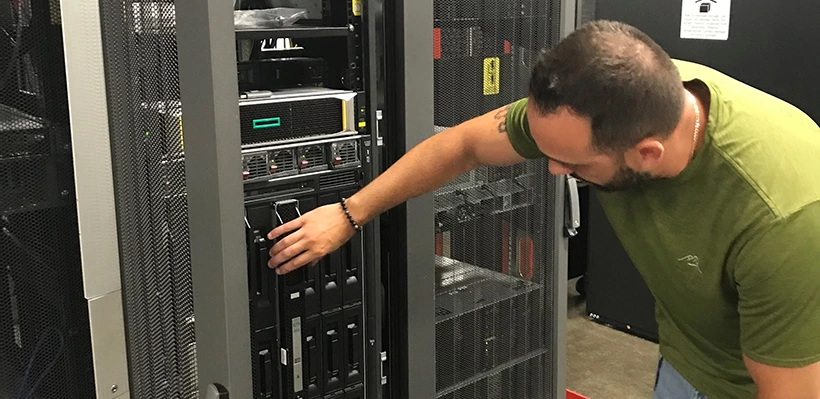
The next step in developing your data center move checklist is to inventory your assets and applications. Decide if you will conduct a manual, software, or dual-based approach to the process.
- Complete an inventory of all IT equipment.
- Determine who owns each asset.
- Complete your network connectivity inventory.
- Inventory all applications you’re currently using.
- Inventory and categorize any undocumented hardware and other equipment.
- Identify which equipment will be moving.
- Have a disposition plan for decommissioned data center assets.
Prerequisites: Environment, Hardware & Software
Order spare hard drives and CPU/memory or have your hardware support vendor on-site with parts and a commitment on how soon additional parts can arrive on-site if needed.
Be prepared with spare media for installation (operating system boot DVDs, application media and licenses) for the worst-case scenario.
Confirm levels of software and hardware support on each piece of equipment.
Involve your network team: This team is crucial to the relocation and they must have network switches preconfigured. Patch panels in the new data center should be tested in advance for both network and storage.
Confirm that the power at the destination is cabled properly with the correct connectors and verify that the network connectivity/availability is working.
Ensure adequate power exists and has been tested.
Ensure sufficient space and ventilation is available for racking
servers.
Hardware Move Checklist – include in the project plan prerequisites and prepare a workaround for problems that could arise during the hardware relocation.
- Is there a loading dock? Is there sufficient height to move the equipment in or out?
- Is a lift gate truck required to access the shipping/receiving dock?
- What will be used to move the equipment to the loading dock?
- Will the equipment fit in the elevator?
- Is there a restriction on truck distance from the building?
- Will there be a forklift and operator available?
- Is there an area for packaging and un-packaging in both data centers?
- Which equipment should be moved first/last? Identify development, staging and production equipment.
- Will equipment need to be un-racked and racked at the new location?
- Will you or a vendor perform cabling work?
New Infrastructure Planning
- Decide where each piece of hardware/equipment will be placed in the new location.
- Use software to create a virtual layout and understand the implications of your choices.
- Work with your engineering team or network flow analysis software to model network design information.
- Plan your connectivity needs accurately to avoid overloaded cabinets.
- Make sure the new layout offers enough power capacity for racks/rows now, as well as in the future.
Pre-Migration
- Have a plan for the day of the migration, including who is responsible for what, the overall timeline, and more.
- If the move will severely impact operations/uptime, consider taking a phased approach.
- Determine whether a migration/relocation service provider will be needed.
- Get to know your new location, including entrances, freight elevators, etc.
- Make sure that every team member has access to the new location.
- Have a disaster recovery plan in place.
- Document new configurations and plan to test operability.
- Take care of any installation that can be done before the move, such as rail kits.
- Make sure all environmental and power distribution sensors are in place, monitored, and configured.

Backups
We all know that backups should be done and are certain that they are being routinely performed, but have you ever tested them? If not, the time to test is now – not after powering the server up in the new location and discovering the last good mirror in your volume group is bad. Hopefully, you currently have a development, QA or staging environment that closely resembles your production environment where you can test recovery. If this is not the case, you need to delay the relocation and test your backups.
Key items to remember:
- OS dumps unique to each OS are critical to restore an OS properly (e.g. ufsdump for Solaris, make_tape_recovery for HPUX, mksysb for AIX).
- Your data for data base (DB) and other applications are most likely on external storage arrays and are being backed up by tape for off-site purposes. Do you have a Disaster Recovery (DR) site with this data being replicated by a storage array or cluster product? Regardless, know and test how you would restore the data in the new data center should things go awry.
- Be ready with media and license keys for installing backup server client software if needed. This would be the second step after an OS install recovery and a prerequisite for restoring the application data.
- Ensure that your backup and build servers are ready to go in the new data center prior to the relocation date. This is optional, but important should you immediately need to perform a recovery after the physical servers are moved.
Gathering a Team and Making the Move
- Make sure that every team member has access to the migration plan in some format, whether hardcopy or digital.
- Verify that all equipment has been delivered to the new location.
- Check that your team members are all present.
- Verify any migration issues and make sure the timeline is still intact.
- Be flexible and prepared for changes.
- Update layout plans as each piece of hardware is installed and configured.
Documentation and Testing
- Make sure that all equipment is operational.
- Connect and verify that the network is operational.
- Conduct a spot audit as necessary.
- Decommission old equipment and practice secure IT asset disposition.
Data Center Migration Tools
While every data center relocation project will vary, a couple of tools will apply across the board. The most important of these is a single pane of glass management setup to ensure that everyone is on the same page and all migration elements are visible.
You can leverage network monitoring software, a project management system, and/or a data center infrastructure management platform to help keep your plan on track.
Find the Right Data Center Relocation Partner
Odds are your IT team isn’t frequently engaged in data center migrations. Finding a partner who is experienced with local, national, and global data center relocations can make the difference between seamless IT operations and a service outage nightmare.
Park Place Technologies is one of the most reputable data center migration companies, and we have the engineers, packers, and project managers to guarantee a green-light to green-light move. Our process includes auto-discovery, move group planning, site auditing, cable/port mapping, asset tagging, cable labeling, and asset disposal planning to mitigate risks and make you look like a hero.
Contact us today to speak with a rep about your upcoming relocation!