

Data Center GPU Deployment Strategy – Why it Matters More Than Ever
Artificial Intelligence

Artificial intelligence (AI) has stopped being a side project for most enterprises. It’s now a core line item in the infrastructure budget, and that shift has rewritten the rules for how organizations plan, purchase, and support the hardware underneath it. GPU-accelerated servers are no longer reserved for research labs. They’re the backbone of production AI, high-performance computing, and advanced analytics across nearly every industry.
Scaling GPU deployment involves far more than chip supply. The numbers behind the 2026 AI buildout show a more complicated picture, one where power, cooling, lead times, and total cost of ownership matter just as much as raw compute.
The difficulty continues after the hardware is racked. The organizations struggling most with AI infrastructure in 2026 usually aren’t the ones who couldn’t afford the GPUs. They’re the ones who underestimated what it takes to keep a GPU environment running once it’s live.
The State of 2026 AI Infrastructure Spending
How the rise of GPUs has Affected Data Centers
Increased Adoption of Liquid Cooling
Build GPU Cluster Deployment in Stages
Use Big Clusters for Training, Distributed Infrastructure for Inference
Treat Lead Time as a Planning Variable
Plan for Power Before you Plan for Compute
7 Best Practices to Plan Around GPU Prices Going Up
Build a Practical Framework to Deploy GPU Clusters
The State of 2026 AI Infrastructure Spending
The size of the current investment cycle is hard to overstate. Global data center capital expenditure is now forecast to exceed $1 trillion in 2026, a milestone that had previously been expected further out, with the multi-year AI buildout projected to push that figure to $1.7 trillion by 2030. Some longer-range models put the number even higher. One widely cited forecast puts annual AI-related capital expenditure at approximately $765 billion in 2026, potentially rising toward $1.6 trillion annually by 2031. (via Haink) (via Spheron)
Hyperscale cloud providers are leading that charge. The top four U.S. cloud providers, Amazon, Google, Meta, and Microsoft, increased data center capex a combined 78% year-over-year in the first quarter of 2026 alone, driven by AI infrastructure buildouts and rising memory and storage prices layered on top of already elevated costs. The trajectory extends well past this cycle. Long-range estimates of $5.2 trillion in cumulative spend by 2030 point to 2026 as a mid-cycle year for AI infrastructure investment. (via Haink)
The GPU data center market specifically is growing even faster than the broader infrastructure category. The global GPU data center market reached $36.88 billion in 2026 and is on track to hit $124.19 billion by 2032, a 22.24% compound annual growth rate that makes it one of the fastest-growing infrastructure asset classes on earth. (via Core Insights)
How the rise of GPUs has Affected Data Centers
Aside from the immense processing power of GPUs, they have also affected the IT infrastructure space in many other ways.
Traditional data center planning was largely a function of floor space and server count. GPU-dense environments break that model. GPU-accelerated infrastructure requires only about 1/40th the physical footprint and 1/20th the power of CPU-only data centers to deliver equivalent AI workload performance, a dramatic efficiency gain, but one that concentrates enormous thermal and electrical demand into a much smaller footprint. That density is what makes AI data center GPU server racks so operationally different from the servers most IT teams are used to supporting.
Increased Adoption of Liquid Cooling
Cooling is often the first system to hit its limits. Traditional air cooling cannot handle GPU rack densities above roughly 30 to 40 kW, which is why data center liquid cooling and other advanced thermal management approaches have moved from experimental to essential in new GPU deployments.
Worsening Power Availability
Understanding the AI GPU cluster deployment impact on power infrastructure has become essential, because power availability is now a bigger constraint than the hardware itself. The real 2026 bottleneck for IT environments isn’t just an AI hardware shortage, such as GPU supply, it’s the decreased availability of power.
Site selection reflects that shift directly. It’s reported that power availability outweighs connectivity in data center site selection, with operators prioritizing locations capable of delivering 300 MW or more of power capacity within tight deployment timelines. (via DC&T Global) (via Data Centre Digest)
That constraint shows up in project timelines across the industry. Colocation vacancy for AI-grade facilities sits at just 1.4% globally, and new power connections to existing facilities routinely take 18 to 36 months to commission.
The consequences are already visible at scale. More than 36 AI infrastructure projects worth a combined $162 billion have been blocked or significantly delayed in 2026 due to power availability, equipment lead times, and local opposition. This is the case, even as hyperscalers spend more than $600 billion this year on AI infrastructure expansion. (via OneSource Cloud)
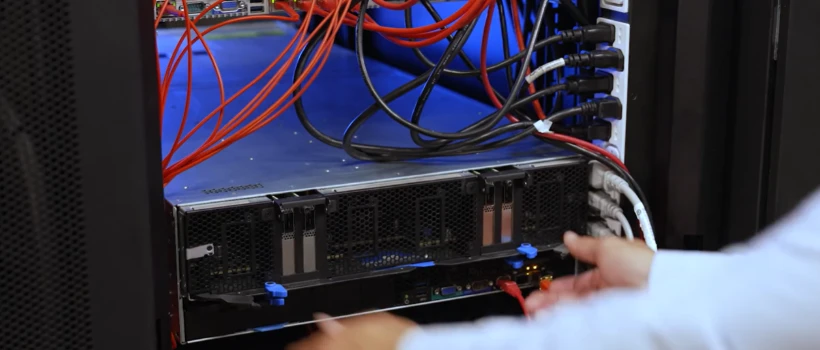
4 GPU Deployment Strategies
Given those constraints, how organizations approach a GPU deployment at production scale matters as much as what they buy. A few strategies have become common practice across the industry.
1. Build GPU Cluster Deployment in Stages
Capacity planning validated on a small cluster rarely holds at production scale. A prototype running efficiently on four GPUs might encounter unexpected bottlenecks at 64 GPUs, since network topology, memory bandwidth, and synchronization patterns that work at small scale often fail at production scale.
The only reliable way to avoid an expensive surprise is benchmarking at representative scale before committing to a full deployment. (via OneSource Cloud)
2. Use Big Clusters for Training, Distributed Infrastructure for Inference
Training and inference have different infrastructure requirements.
Training a large model is one enormous, tightly coupled workload. It runs best on a big, dense cluster where a lot of GPUs sit close together on fast interconnects and work the same problem at the same time. Slow down one node and the entire run slows with it, so density and consistency matter more than anything else.
Inference works the other way. It’s a constant stream of small, independent requests that need to be answered quickly, close to the user, and without interruption. That workload runs best on capacity spread across regions, sites, and edge locations, so it can absorb demand spikes and keep serving if a single location goes down.
Most organizations get into trouble by picking one shape and applying it to everything: building a single monolithic cluster and then trying to serve production traffic out of it, or spreading capacity so thin that training runs never get the density they need. The practical approach for 2026 is to plan for both, concentrated capacity for training and distributed capacity for inference.
The trade-off is that running both roughly doubles the operational surface area. Two very different environments, often in different facilities and on different hardware generations, all of which have to stay healthy at once.
3. Treat Lead Time as a Planning Variable
GPU procurement timelines have been unpredictable. Enterprise buyers without existing vendor relationships or standing commitments are facing lead times of six to twelve months for large GPU cluster orders. While lead times for high-end GPUs have stretched to six to twelve months during 2025, with similar constraints expected to persist through 2026.
Organizations that build procurement timing into their AI roadmap avoid the stalled projects that have become common industry-wide.
4. Plan for Power Before you Plan for Compute
Since power is now a binding constraint on most deployments, site selection and utility negotiations need to start earlier in the process than they historically have.
That means engaging with power providers and evaluating grid capacity in parallel with hardware procurement.
7 Best Practices to Plan Around GPU Prices Going Up
With GPU prices rising across nearly every tier, the cost story around GPU infrastructure has become just as complex as the deployment story, and the numbers involved are large enough that a poorly chosen acquisition model can materially affect a company’s bottom line.
1. Understand the True Price of Density
Facilities that once cost around $10 million per megawatt increasingly require $15 million to $25 million or more per megawatt once GPU clusters, networking systems, and power infrastructure are factored in.
Hardware itself is a major driver of that increase. High-end GPUs frequently cost more than $25,000 per unit, and large AI clusters may contain tens of thousands of processors, meaning server infrastructure alone can exceed the cost of the physical building housing it. (via Spheron)
2. Match the Acquisition Model to the Workload
The right infrastructure depends on how a workload behaves. The acquisition model an organization chooses determines whether GPU costs land as capital expenditure or operating expenditure.
On-demand cloud rental charges by the hour with no commitment and suits variable or exploratory workloads, while reserved or committed-use contracts reduce hourly rates by 24 to 75 percent in exchange for one-to-three-year commitments.
For steady, predictable workloads, that trade-off usually favors commitment. For experimental or bursty workloads, flexibility is worth the premium.
3. Watch for Pricing Volatility
GPU rental pricing has swung sharply. H100 one-year lease contract prices rose approximately 40 percent over five months into early 2026, driven by massive inference demand from proliferating open-source models and production AI deployments, after declining through late 2025.
Swings like that mean budgets built on last year’s pricing can be outdated within months, which argues for building pricing flexibility into any multi-year AI infrastructure budget.
4. Consider a Hybrid Ownership Model
Full cloud and full on-premise ownership sit at two extremes, and most organizations land somewhere in between. Most enterprise AI infrastructure leaders now operate a hybrid model, owning or colocating GPU clusters for baseline production workloads while using cloud capacity for burst demand and geographic redundancy.
The economics support that approach. GPU colocation offers a cost-efficient middle path between full cloud and on-premise ownership, with mid-market AI inference deployments running $28,000 to $39,000 per month versus $480,000 to $600,000 annually on hyperscaler cloud. (via Core Insights)
5. Push Utilization as High as Possible
Underused GPU capacity is one of the most common ways AI budgets quietly balloon. Enterprises running GPU workloads at 70% or higher sustained utilization reduce total cost of ownership by 40 to 60% compared to equivalent public cloud spend.
Utilization discipline, through workload scheduling, orchestration, and right-sizing, is often a bigger cost lever than the underlying hardware price.
6. Build in Cost Governance
Usage-based AI pricing can produce budget surprises that traditional IT cost models never had to account for. Uber publicly acknowledged exhausting its annual AI budget by April 2026, with one engineer’s token consumption alone reaching $40,000 per month (via Forbes). That’s a structural risk of usage-based AI pricing operating without adequate cost governance.
Organizations that treat AI compute spend the way they’d treat any other high-variance operating cost, with real-time infrastructure monitoring, spending caps, and accountability at the team level, are far less likely to get blindsided.
7. Account for Data Movement Costs
Storage and egress fees are an often-overlooked line item. Organizations that build AI infrastructure in public cloud environments accumulate large volumes of data, training datasets, model weights, inference logs, vector databases, that eventually needs to move.
Data egress fees can become a structural cost trap if that movement isn’t planned for in advance.

Build a Practical Framework to Deploy GPU Clusters
A workable GPU infrastructure strategy for 2026 rests on a few consistent principles:
- Plan for power availability before compute availability.
- Choose an acquisition model that matches actual workload behavior.
- Build cost governance into the AI budget from day one.
- Match infrastructure to workload: dense clusters for training, distributed capacity for inference.
- Staff and support for the ongoing operational load beyond initial deployment.
Cost gets the attention, but complexity is what stalls projects. GPU infrastructure is constrained by physical realities like power, cooling, and site readiness, and it demands a level of ongoing operational attention that most IT organizations have never had to provide before.
Organizations that treat deployment and day-to-day operations as seriously as they treat the AI models themselves are the ones successfully moving from pilot projects to production at scale.
The Operational Reality of Running GPU Infrastructure
Everything above is about getting GPU infrastructure in the door. The harder part starts the day it goes live. Very little of the ongoing difficulty is about the GPU itself. It’s about the environment around it, and it shows up in four places.
1. Deployment Readiness
A GPU server changes the requirements of the rack it goes into. Before anything gets powered on, someone has to confirm floor loading, rack depth and weight limits, power whips and PDU capacity, network fabric readiness, and whether the loading dock can physically accept a delivery that may weigh several thousand pounds per rack. Sites that skip the readiness assessment tend to find the gap after the hardware shows up, which is the most expensive possible moment to find it.
2. Impact on Power Cooling
Racks that used to draw 5 to 10 kW now draw 40 to 130 kW or more. That turns the thermal and electrical review from a formality into a real engineering exercise: available circuit capacity, redundancy design, airflow containment, and whether the room can support direct-to-chip liquid cooling or needs a rear-door heat exchanger as a bridge. Downtime is the obvious risk. Thermal limits also throttle the GPUs you already paid for, long before anything actually fails.
3. Distributed Footprint
AI infrastructure is rarely in one building. Enterprises end up with training capacity in a core facility, inference capacity in regional sites, and increasingly some inference at the edge. Supporting that footprint means spare parts staged near every location, customs and import handling across borders, engineers who can physically reach a site inside the response window, and one accurate view of what is installed where. Support models built around a handful of major metros leave gaps.
4. Equipment Lifecycle Factors
GPU fleets age unevenly. Most organizations end up running two or three hardware generations side by side, each with its own firmware baselines, driver dependencies, and support status. Add the interoperability testing multi-GPU systems demand, OEM refresh cycles that move faster than the business needs them to, and the fact that every node out of service is capacity already paid for, and lifecycle management becomes a continuous discipline.
These are operational problems, and they’re the reason organizations bring in a support partner. GPU environments at scale are complicated, and most IT teams were never staffed to run them.
Utilize a Partner for Enterprise GPU Infrastructure Support
Park Place are the ideal partner to work with you alongside GPU support and deployments. We deliver enterprise-grade, global third-party support for GPU servers across data centers, edge locations, and hybrid environments. We are backed by GPU-specific engineering expertise spanning GPU-dense server architectures, TPU circuits, advanced cooling and power configurations, and AI accelerator-focused systems.
We’ve seen a growth in bookings in the AI infrastructure space of 275% year-on-year and this is due to our engineering reliability and support capabilities in the AI space.
That support covers the full operational surface described above: deployment readiness, power and cooling assessment, global parts logistics, and lifecycle management for mixed-generation fleets, so the day-to-day burden of keeping a GPU environment healthy doesn’t land entirely on your team.
With customer deployment environments spanning more than 60 data centers globally and support for more than 24,000 servers and over 76,000 GPUs to date, Park Place Technologies gives organizations a way to scale AI infrastructure without being constrained by traditional vendor support models. We pair global reach with the specialized expertise that GPU-dense environments now demand.
Buying GPUs is a procurement problem. Running them is an operations problem. We solve the second one.
Frequently Asked Questions:
-
How much does GPU cost?
New data-center GPUs generally run somewhere between $25,000 and $40,000 for an H100, and roughly $30,000 to $50,000 for the newer B200. A fully built GB200 NVL72 rack can climb past $3 million. Renting through the cloud instead costs about $1 to $7 per GPU-hour.
-
When will GPU prices drop?
It's partly underway already, with used H100s having slid to around $12,000 to $18,000 as supply loosens up. The newest chips are holding firm, though, since demand is still running well ahead of supply, and that gap is expected to stick around for another 18 to 24 months.
-
Why are GPU prices so high?
Largely due to bottlenecks in the supply chain. The advanced packaging step at TSMC can't scale quickly enough, and the specialized high-bandwidth memory these chips need is in short supply with only a handful of makers, all fully booked, while AI demand keeps climbing.