

Data Center Performance Monitoring – Importance, Metrics, and Tools
Entuity Software

Today’s data centers tend to be vast and highly complex. They’re true ecosystems. They are home to thousands of digital “organisms,” such as servers and storage arrays that consume limited supplies of electricity and air much like animals who inhabit a natural habitat. And, just as a biological ecosystem can become unbalanced, with negative effects on resident wildlife, so too can a data center lapse into poor performance.
This results in energy inefficiency, shortened hardware lifespans, and degraded user experience. The practice of data center performance monitoring is essential for mitigating this risk and monitoring data center performance enables administrators to respond to problems quickly.
What is Data Center Performance Monitoring?
Benefits of Optimizing Data Center Performance
9 Data Center Performance Metrics to Look Out For
4 Tools for Monitoring Data Center Performance
1. Full-stack observability and Application Performance Monitoring (APM)
2. Data Center Infrastructure Management (DCIM) Tools
3. Data Center Network Monitoring Tools
4. Real-Time Data Center Asset Monitoring
Data Center Performance Management from Park Place Technologies
What is Data Center Performance Monitoring?
Data center performance monitoring is a multi-threaded set of activities that continuously measure, analyze, and respond to the operational performance of a data center’s many infrastructure elements. For example, servers, storage devices, and network devices, along with the associated software programs that support them.
The process collects data center performance metrics such as server uptime and power usage effectiveness (PUE). The goal is to facilitate maximum uptime, optimal energy usage, and operational efficiency while preventing costly data center outages.
Benefits of Optimizing Data Center Performance
With IT infrastructure being so critical to a business’s operations, consider the following reasons why it pays to optimize data center performance:
- Reduced downtime—Data center performance problems can lead to downtime. This might happen when the infrastructure experiences “resource saturation” and equipment times out, causing a cascading series of system failures.
The costs are huge too. Downtime can cost thousands of dollars per minute in lost revenue and remediation costs. According to a 2024 Oxford Economics IT downtime study, downtime costs for Forbes Global 2000 total $400 billion a year. This translates into an annual average loss of $200 million per company. Data center uptime monitoring, leading to uptime optimization, helps avoid these costs.
- Lower energy consumption—Data centers use enormous amounts of electricity. Energy is not only one of the biggest costs of running a data center. It also affects sustainability. Data centers when not properly managed can become inefficient with energy use. The Uptime Institute surveyed data center operators and concluded that over 65% of the power used in data centers processes a mere 7% of the data center’s workload. For these reasons, keeping energy consumption low is a major benefit from data center optimization processes.
- Lower operating costs—A data center that’s optimized for performance will also be optimized for costs. In addition to keeping energy costs low, data center performance optimization also keeps administration headcount manageable, as there will be fewer trouble tickets to address.
- Better capacity planning—If your infrastructure elements are optimized for performance, you will have an accurate sense of where you should add capacity. Conversely, if you don’t have good awareness of performance, you could easily invest in adding capacity where it’s not needed and underinvest in areas where you do need it. This leads to optimized capital expense (CapEx) spend.
- Longer hardware lifespan—Poor performance can affect hardware longevity. For example, hardware degrades more quickly if it generates more heat than necessary, which happens when a server is “running hot” with an unnecessarily high load. You will have to replace that server sooner than you planned. Ensuring that your equipment is running optimally can help your device run for several years beyond its End of Service Life date.
- Improved end-user experience—Better data center infrastructure performance translates into better end-user experiences. When systems are running optimally, it translates to fewer slow or lagging systems, which in turn lowers the number of customer support calls. Keeping your data center performance optimized will keep you in compliance with service level agreements (SLAs) and reduce the likelihood of an unhappy customer.
9 Data Center Performance Metrics to Look Out For
Data center performance optimization requires adequate measurement. These include measures of uptime, system performance, power consumption, cooling, and sustainability. Here are 9 of the most common and important performance metrics to track:
1. Availability and Uptime
This metric tracks the percentage of time that the data center is operational vs. experiencing an unplanned outage. It’s usually described in terms of “nines,” e.g., 99.999% uptime, which is “five nines.”
2. Network Latency
Network latency measures the time it takes for a packet of data to make a round trip across the data center’s network. It is important to track this metric for several reasons.
For one thing, network equipment performance issues can affect capacity planning. It’s also essential to differentiate between system performance issues that are related to server or storage problems and network latency. If you don’t understand what is driving the slow system response, it is much harder to remediate the problem.
3. Server Utilization
While not strictly a performance metric, server utilization is nonetheless a significant data point to understand capacity planning and other data center performance analysis. It measures how effectively hardware, comprising memory, and CPU is being used.
If a server is overloaded, its utilization will be high. Knowing this enables you to balance workloads and establish performance “headroom” to avoid performance problems as demand increases.
4. Application Performance
Application performance may not always be related to data center performance, but it is useful to track how applications are performing because a slowdown in an application can reveal an underlying infrastructure problem. Additionally, applications are where end users typically experience a data center performance issue, so it’s a good idea to track the metric and get out ahead of user experience problems.
5. Power Usage Effectiveness (P.U.E.)
PUE is the ratio between total facility energy consumption and energy used to power the actual digital infrastructure.
A PUE of 1.1, for instance, means that for every kWh of electricity used by infrastructure equipment, 1/10 of a kWh goes to power the data center’s lighting, office equipment, etc. The lower the PUE, the more energy efficient the data center is.
6. Cooling Efficiency Ratio (CER)
CER is a measurement of a data center cooling system‘s efficiency. The number represents a comparison between heat removed from the infrastructure and energy consumed by cooling systems.
7. Cabinet Temperatures & Delta-T
These are metrics that represent air intake temperatures and the differential (Delta-T) between cold aisle air temperature and hot aisle exhaust temperature. They are useful for identifying thermal hotspots in the data center and optimizing airflow, leading to optimized cooling system configuration.
8. Water Usage Effectiveness (WUE)
Data center water usage is becoming a contentious issue as hyperscale facilities start to impinge on local water supplies. WUE thus emerges as an important metric to track, as it measures how much water is used for cooling and operations in relation to the total energy used by the IT infrastructure. This helps the data center operator understand their water usage footprint and set goals for improvement.
9. Carbon Usage Effectiveness (CUE)
CUE is a comparison metric that tracks an IT infrastructure’s total carbon emissions in relation to the energy used by its infrastructure equipment. It’s an important data point for measuring the environmental impact of data centers and sustainability.

4 Tools for Monitoring Data Center Performance
The technology industry offers a wide range of tools for monitoring data center performance. Some are proprietary and others open source; some are highly specialized, while others serve general purposes with overlapping capabilities.
They fall into four broad categories: full-stack observability and Application Performance Monitoring (APM), Data Center Infrastructure Management (DCIM), network monitoring, and real-time data asset monitoring. Some solutions offer features that span these categories.
1. Full-stack observability and Application Performance Monitoring (APM)
As its name suggests, a full-stack observability platform monitors the data center’s entire technology stack, from the network switches to operating system (OS) code. Application performance monitoring will likely be part of such an offering, but you can set up a separate APM solution if that suits your needs. APM is a type of software that monitors application health, assessing factors such as availability and responsiveness.
2. Data Center Infrastructure Management (DCIM) Tools
DCIM tools monitor the data center’s physical facilities. They continuously collect telemetry in real time from the data center’s hardware, for example, servers, storage and network telemetry, as well as cooling units and uninterruptible power supply (UPS) units.
The DCIM then stores this data centrally in order to analyze it, detect problems, and even predict problems before they occur. This setup makes the DCIM a key tool for optimizing data center performance.
3. Data Center Network Monitoring Tools
For network operations (NetOps) admins, network monitoring tools often play a critical role in their day-to-day management of the data center. Utilizing a reputable monitoring tool to keep track of key network metrics and gather data from any device that supports Simple Network Management Protocol (SNMP) is critical to ensuring that the broader environment is operating efficiently. Additional data center infrastructure monitoring may be undertaken by leveraging APIs, Streaming Telemetry, and OpenTelemetry.
Software that monitors networks should also conduct continuous or automated network discovery to maintain an up-to-date inventory of network assets. This capability helps with the identification of trouble spots while supporting capacity planning, as well as identifying new growth needs for your network.
Some vendors also offer network path monitoring, flow analysis, database monitoring, and configuration management as a part of their solution. When evaluating network monitoring tools, confirm whether these features are included out-of-the-box or sold as an add-on functionality, as it varies across vendors.
4. Real-Time Data Center Asset Monitoring
A number of solutions help you proactively monitor data center hardware faults and track how your hardware is performing at a granular level. These software solutions monitor hardware, proactively predicting and identifying hardware faults. The most robust tools then open incident tickets, triage issues, and dispatch engineers immediately. These tools can be provided by hardware vendors for OEM-specific monitoring, while third-party solutions are better suited for managing multi-vendor environments.
In addition to this, hardware performance monitoring tools now exist that improve asset performance and operational functionality. These tools function by setting a baseline of data center equipment performance and then continuously monitoring these devices to detect when they are not operating to their defined target performance range.
Data Center Performance Management from Park Place Technologies
Data centers are sprawling infrastructures that house an immense amount of hardware. With so many devices, tracking the performance of each, as well as the entire infrastructure, could be difficult.
Park Place removes that complexity and allows you to focus on what really matters, through a range of solutions that monitor the performance of your data center.
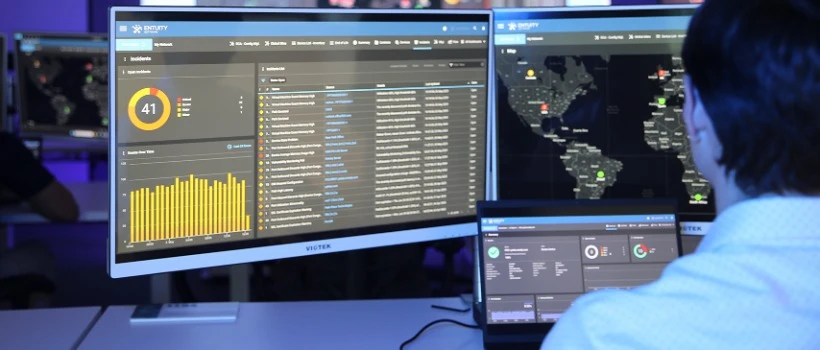
Entuity Software™ is our proprietary infrastructure monitoring tool. Entuity’s dashboards deliver real-time visibility into infrastructure performance through intuitive visualizations and customizable dashboards, helping IT teams prevent and resolve issues fast. Entuity can comprehensively monitor your entire estate, only alerting you to important performance issues.
Our ParkView® suite is also available as an add-on to our third-party maintenance service, which monitors your hardware devices closely, ensuring a smooth-running IT infrastructure:
- ParkView Automated Support™ – With our preventative hardware monitoring tool, device issues are detected instantly. Our team is then alerted, triage begins, and engineers receive full diagnostic data for fast, accurate resolution. This means downtime is reduced significantly.
- ParkView Performance Insights™ – Our monitoring solution proactively tracks hardware performance, detecting threshold breaches and ensuring equipment is remediated and returned to optimal state.
Contact Park Place Technologies today to learn more about our uptime monitoring solutions.
Frequently Asked Questions:
-
How to optimize the performance of data center switches?
To optimize the performance of data center switches, it is first necessary to monitor network latency and switch utilization. With this information, it is possible to allocate network traffic load in ways that maximize throughput without overloading any switches.
-
How to evaluate the performance of my data center's hardware?
Evaluation of data center hardware performance starts with monitoring hardware across metrics that include response time, the granular performance of CPU and memory, and disk I/O latency. It is also a good practice to measure the power and cooling characteristics of hardware, along with utilization levels. These data points come together to create a picture of how well a particular piece of hardware is performing along multiple dimensions.