

Rear-Door Heat Exchanger Cooling – How Effective is it?
Liquid Cooling

Most data center managers are locked in a struggle between the need for density and the need to keep equipment cool. Dense hardware tends to generate too much heat, which negatively affects performance. At the same time, some data center cooling solutions have their limits, such as an enormous power consumption bill. For reference, cooling systems can consume 40% of the total power used by the data center.
However, the rear-door heat exchanger (RHDx) offers a solution. With rear-door cooling, it is possible to cool hardware at the level of the individual rack, a capability that provides effective, economical cooling that enables greater density.
What is a Rear-Door Heat Exchange?
How is Rear-Door Cooling Implemented?
Different Types of RDHx Cooling
Active Rear-Door Heat Exchanger
Active vs Passive Rear-Door Heat Exchanger
Rear-Door Cooling Benefits vs Other Data Center Cooling Methods
How RDHx Cooling Can Fuel AI Growth
Rear-Door Heat Exchanger Services from Park Place Technologies
What is a Rear-Door Heat Exchanger?
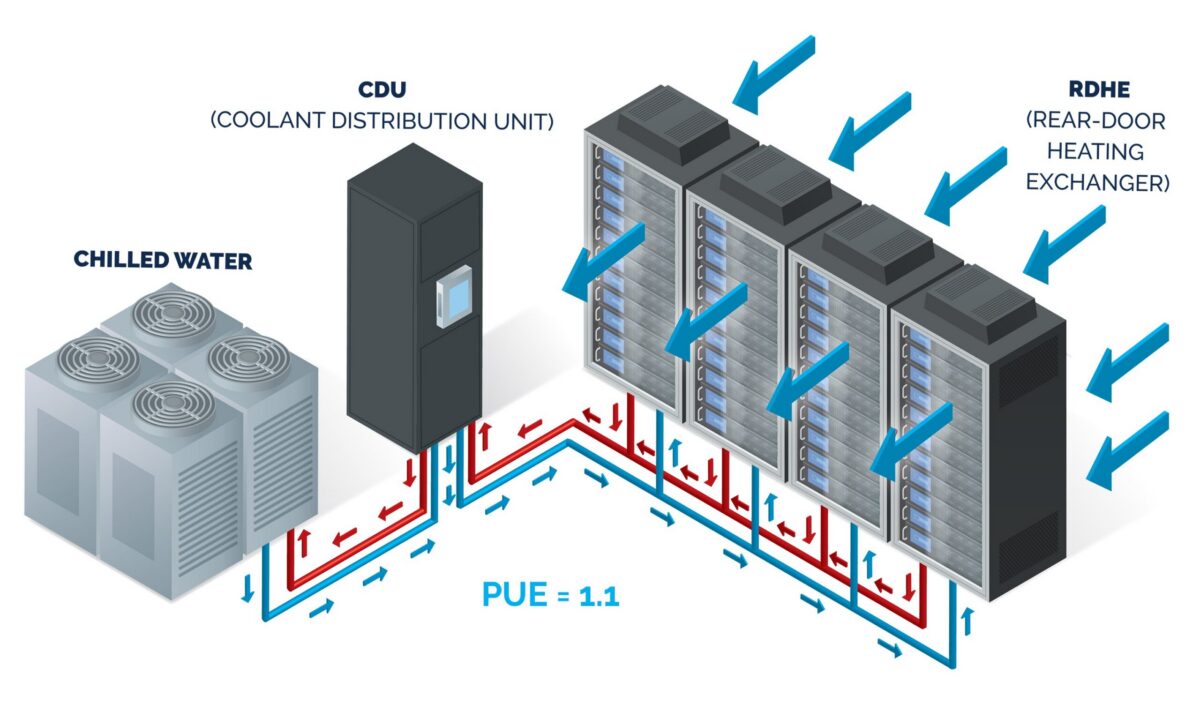
A rear-door heat exchanger is a data center cooling device mounted on the rear side of a server rack.
It typically uses a liquid-based cooling process where a coolant, such as glycol or chilled water, flows through coils (usually made of copper) that cool the warm air generated by the hardware on the rack. This approach cools air before it reaches the larger data center space. As a result, it reduces the thermal load placed on the data center’s air conditioning (HVAC) system.
With this approach, it is possible to achieve greater hardware density while increasing power efficiency.
How is Rear-Door Cooling Implemented?
Rear-Door implementation involves an IT technician removing an existing server rear door and installing the cooling unit. After that, the technician connects hoses carrying the coolant to the unit from a coolant distribution unit (CDU). The installation process also includes steps to seal the door to prevent air leaks.
Implementing rear-door cooling is not a complicated undertaking in most cases. Many standard data center racks, such as those made by HPE, Dell, and others, are designed to accommodate rear-door cooling units. If the rack is not manufactured to support rear-door cooling, retrofitting is possible with experienced installers.
Different Types of RDHx Cooling
There are two standard approaches to RDHx cooling: active and passive. They differ in the way they handle hot air generated by hardware in the rack.
Active Rear-Door Heat Exchanger
As its name suggests, active rear-door cooling uses its fans to push hot air generated by electronic equipment actively through the cooling coils. The fans are built-in and set up to draw in this exhaust air.
The coils enable the heat exchange process, in which thermal energy from one medium (the hot air) is transferred to another (the cooling fluid) without mixing them. The system pumps the warm liquid away and either recools it or replaces it with fresh coolant fluid to absorb more thermal energy from the hot exhaust air.
Passive Rear-Door Cooling
A passive rear-door heat exchanger does not employ fans to move air into the heat exchanger. Instead, it relies on natural convection, with the airflow created by the hardware’s internal fans driving air into the cooling coils.
Active vs Passive Rear-Door Heat Exchanger
The factors affecting the choice between an passive vs active rear door heat exchanger will depend on the use case, as well as practical and financial considerations. In particular, the workload and the cost pressures facing the data center managers will guide the choice.
Active rear-door systems are generally better for high-intensity heat situations, such as high-performance computing (HPC) necessary for artificial intelligence (AI) growth. Passive systems are preferable in situations where the emphasis is on reducing energy costs and simplifying maintenance.
Passive systems contain no fans that consume electricity or break down. However, without fans, passive systems are not optimal for workloads that generate extreme heat.
The table below shows the advantages and disadvantages between both rear-door cooling methods:
| Active RDHx | Passive RDHx | |
| Best use case | Data centers running high-density (HPC) and/or artificial intelligence (AI) hardware workloads. | Data centers with moderate density. |
| Advantages |
|
|
| Disadvantages |
|
Cooling is constrained by the air-moving capacity of built-in server fans. |
5 Benefits of RDHx
RDHx offers some key advantages over other data center cooling methods:
- Enables a favorable Power Usage Effectiveness (PUE), e.g., a PUE of 1.1.
- Enables increased density of GPU and CPU workloads.
- Allows maximum wattage user per rack, for example, over 100KW.
- Allows for a reduced amount of server throttling, which can occur when heat requires lower performance levels.
- Minimizes infrastructure disruption, i.e., with directly mounted units and the use of standard cooling infrastructure, RDHx usually requires few changes to the data center environment.
Rear-Door Cooling Benefits vs Other Data Center Cooling Methods
RDHx solutions are generally more effective than alternatives in cooling high-density environments. They can achieve this outcome because they provide localized cooling right at the source of the heat. Here are some direct comparisons to consider.
-
RDHx vs. Computer Room Air Conditioning (CRAC) — CRAC cools the entire data center. This is useful for low- or moderate-density environments, but CRAC does not do well with the heat generated by high-density server racks, e.g., those set up for AI workloads. In these cases, CRAC systems may be unable to deliver thermal efficiency.
In contrast, because RDHx chills air at the level of the rack, hot air is kept from entering the data center. Generally, when comparing air cooling vs liquid cooling in the data center, liquid cooling’s thermal efficiency is superior.
-
RDHx vs. In-Row Cooling — In-row cooling involves the placement of specialized cooling units between server racks. These units chill hot air coming out of the racks before it reaches the broader data center space.
In-row cooling is more precise in its airflow management than CRAC. However, in-row cooling is less localized than rear-door heat exchangers, so it is not usually as effective in high-density environments.
- RDHx vs. Liquid Immersion Cooling—The immersion cooling process involves submerging IT hardware into a container of chilled coolant, e.g., non-conductive fluid. It is very effective in localized cooling of high-density systems. Liquid immersion cooling is generally more effective at achieving localized cooling than RDHx, but it can be more difficult to maintain.
-
RDHx vs Direct Liquid Cooling (DLC)—DLC, or direct-to-chip cooling, is a cooling technology that involves the circulation of liquid coolant in the hardware itself, e.g., onto cold plates attached to components that generate heat, such as CPUs and GPUs.
Direct-to-chip cooling for data centers is effective for HPC and other high-density workloads. It is often better at thermal management than RDHx, but, like immersion cooling, it is comparatively more challenging to manage. This highlights a key benefit of rear-door cooling.
5 Challenges of RDHx
While RDHx offers desirable thermal management and desirable financial outcomes, the technology comes with some challenges. They include:
-
Liquid management risks — Introducing liquid into a data center can be risky and leaks can damage expensive and sensitive equipment. For reference, an RDHx unit might contain a gallon or more of water.
A leak detection system is essential. Also, the unit may rust if it is not made of aluminum or does not feature a special coating. Condensation, too, can be an issue that requires mitigation, e.g., through the use of dehumidifiers. It is essential that data center liquid cooling is undertaken by professionals, to eliminate risk.
-
Potential Higher upfront costs—The long-term total cost of ownership (TCO) for RDHx is favorable, but the rear-door heat exchanger cost per rack, can add up to a more expensive capital investment (CapEx) than for traditional air cooling solutions.
In addition to the rear-door heat exchanger price, there are outlays for supporting equipment, such as coolant distribution units (CDUs) and, in some cases, supplemental flooring support for increased rack weight. Again, experts should be consulted before planning begins to adopt RDHx.
- Retrofitting complexity — If one is not building a “green field” data center, it can be costly and complex to retrofit an existing facility for RDHx. Flooring may also require reinforcement and ceiling height can be an issue, too, due to the need to install pipes. Additionally, the RDHx unit may complicate rear-door access for server maintenance.
- Mechanical risks — The integrated pumps, fans, and cooling coils in RDHx systems can break, in which case temperatures can quickly rise. Although all data center cooling approaches run this risk, it emphasizes importance for regular data center maintenance. Additionally, a redundant system can be helpful to mitigate the impact of a breakdown.
-
Reduced flexibility — RDHx may not be optimal for a dynamic environment, e.g., data centers that frequently change workloads and hardware configurations. RDHx may impede changes in hardware.
On a related front, there is now no standardization for fluid and electrical interfaces on racks, an issue that can disrupt plans to change hardware deployments if RDHx is in use.
How RDHx Cooling Can Fuel AI Growth
RDHx may be a key enabling factor in the growth of AI. Consider the following four reasons this is the case:
- Facilitating rack density — AI does best with high rack density, due to the need for processing speed and fast interconnects. The closer each AI server is to another, the better the AI solution will work.
- Managing AI’s higher heat output — AI workloads depend on graphical processing units (GPUs), which can generate up to 10X the heat of a traditional CPU. RDHx provides localized, effective heat reduction for this hot workload.
- Enabling AI without the need to overhaul the entire cooling infrastructure — By working at the level of the rack, RDHx makes it possible to run AI workload without having to redo the entire cooling operation, e.g., by upgrading CRAC or installing liquid immersion cooling or seeking a direct-to-chip service.
- Avoiding maxing out the energy supply — AI workloads generate so much heat that, without energy-efficient RDHx cooling, AI may use up all available power and put a strain on the local power grid.
Rear-Door Heat Exchanger Services from Park Place Technologies
Rising rack densities and growing sustainability pressures are pushing IT managers to rethink traditional cooling, to adapt to changing times. Liquid cooling is quickly emerging as a compelling option, especially rear-door heat exchangers.
Park Place Technologies can plan, install and provide continued maintenance for your rear-door cooling equipment. We serve as your single-vendor solution for the entire data center cooling process, meaning minimal disruption and simplified management.
Contact Park Place Technologies today to learn more about our RDHx offering and range of liquid cooling options.